Fusing “Oshikatsu” (Supporting Favorites) with Car Life: Beyond the Exterior and into the Cabin
For car enthusiasts, customizing their beloved vehicles to their own tastes is a tremendous joy. Among these customs, “Itasha”—cars adorned with anime and video game characters—has garnered deep-rooted popularity and passion as a uniquely Japanese car culture.
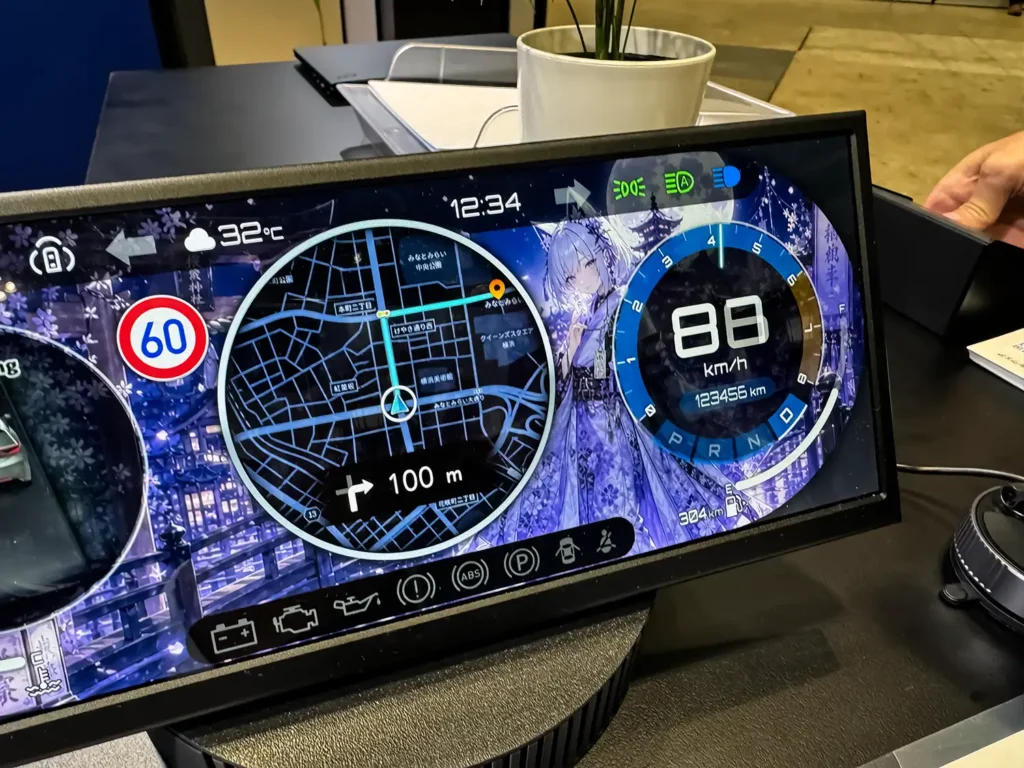
CRI Middleware Co., Ltd., a company handling game development software, has set its sights on this highly passionate Itasha culture. They brought a groundbreaking demo to Japan Mobility Show Bizweek 2026 that expands the possibilities of “Oshikatsu” (supporting one’s favorites) beyond the vehicle’s exterior and into the “interior cabin space.”
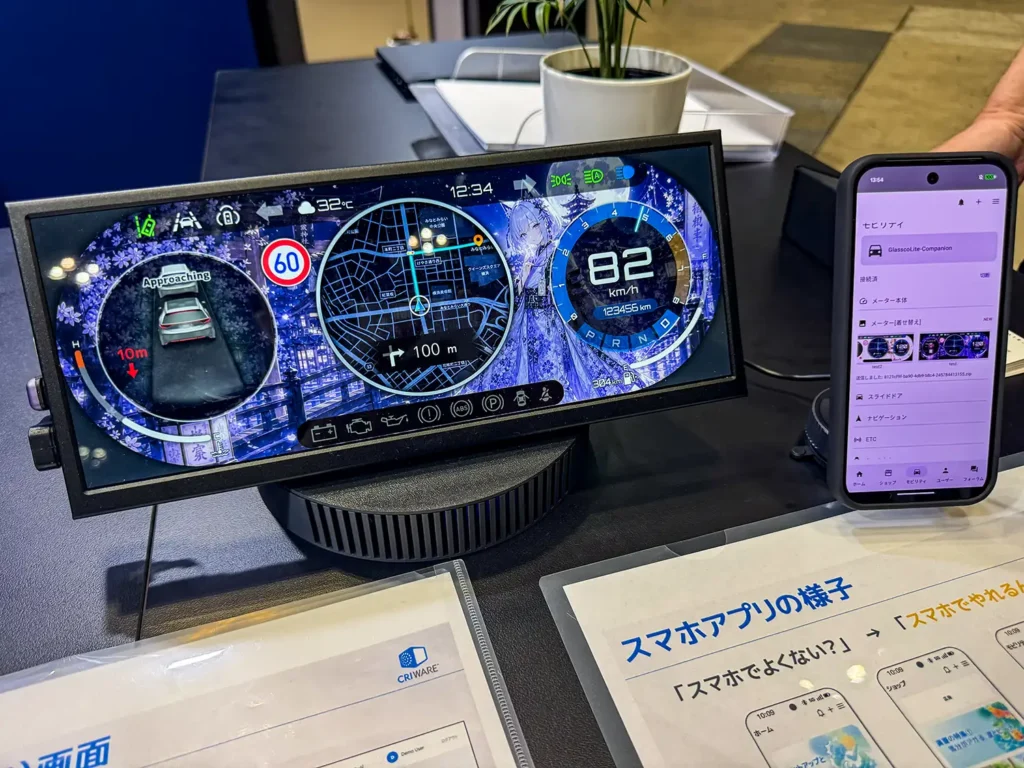
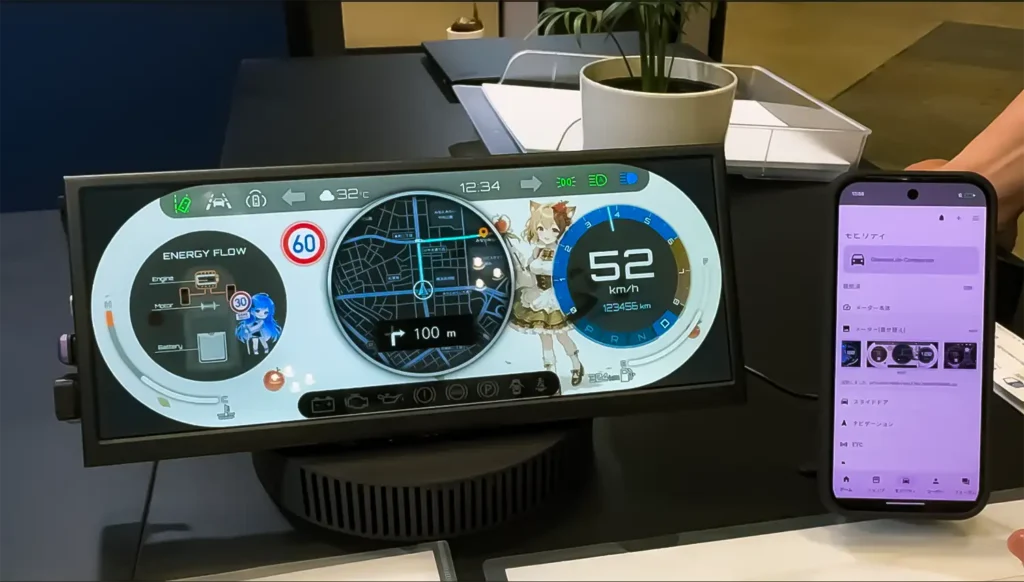
That demo is the “Naka-Itasha” (Interior-Itasha) introduced here. It allows users to easily customize the graphics on the instrument panel and sounds—such as the engine startup audio—to their liking via a smartphone app, effortlessly transforming the car interior into a space dedicated to their “Oshi” (favorite character).
This is an initiative unique to a company that drives both game development software and the transition of mobility into SDVs (Software-Defined Vehicles).
Self-Satisfaction is Key! Making the Cabin Fun and Safe Through the Power of Entertainment
How was the “Naka-Itasha” concept born? According to Fumihito Kondo, the head of development, when conceptualizing a new HMI (Human-Machine Interface) internally, the team utilized “Maslow’s Hierarchy of Needs” to deepen their discussions.
(Tips: What is Maslow’s Hierarchy of Needs? A theory proposed by American psychologist Abraham Maslow, suggesting that human needs are arranged in a five-tier pyramid.)
CRI Middleware analyzed that rather than targeting the higher-level “need for approval from others (= exterior Itasha),” focusing closer to the pyramid’s base on “comfort and self-satisfaction for oneself (= Naka-Itasha)”—a desire shared by many—would offer a broader market base, which became a hint for development.
Kondo explains: “Traditional ‘Itasha’ that decorate the exterior require a high level of the need for approval to appeal to others; it’s a realm reached only by a select few. On the other hand, ‘Naka-Itasha’ is for self-satisfaction, a realm where we can target a much larger demographic. Just as you would decorate your room with plushies and merchandise of your favorite characters, we believe the car interior will also become a fun space tailored to the individual.”
Furthermore, the power of “sound” is significant. “For example, if a favorite character’s voice says, ‘Please drive safely today,’ the driver’s awareness of safe driving may increase, potentially lowering the accident rate as a result. We want to contribute to safety while making the car interior enjoyable through the power of entertainment.”
Of course, because it is a car, safety is the top priority. “Areas related to regulations, such as the turn signal arrow patterns and sounds, cannot be changed. We also strictly prohibit placing videos behind the meters. Humans naturally look at moving objects, which could cause distractions and lead to accidents.” In this way, they provide freedom of customization built upon a foundation of thorough safety considerations.
A Market of 1.2 Billion Vehicles: A Platform Attracting Creators and IP Holders
The experience brought by “Naka-Itasha” is not limited to specific fans. “Some people might enjoy displaying the meter of a car they used to drive to ‘inherit its soul.’ Also, when sharing a car with family, if an elderly person is driving, they might prefer ‘larger text on the meter.’ Thus, it becomes a system that stays close to the ‘ease of driving’ tailored to the driver.”
This system could also present a new business opportunity for content vendors. “Companies could distribute designs for free, almost like advertising. Alternatively, creators might sell meter designs and sounds much like they sell LINE stickers.”
According to CRI, the number of mobility vehicles equipped with LCD screens has currently surpassed 1.2 billion worldwide, now exceeding the scale of home video game consoles (approx. 1 billion units). “As a platform with screens, it is sufficiently attractive, and we believe it will be conveyed to IP holders as a new venue for expansion.”
Balancing “Data-Driven” and “In-Vehicle Safety” Supported by Game Development Expertise
Customizing a car’s meters via a smartphone. The convenience behind this is supported by the technology CRI Middleware has cultivated.
The greatest strength lies in the “data-driven” mechanism. “We are doing the same thing as being able to listen to a music file identically on a PC or a smartphone. Graphic binary data is placed on a server and played back by the ‘HMI Player’ on the car side. Because it automatically links speed and RPMs by treating them like volume knobs, it can run in various environments without any programming changes.”
At the same time, they leave no stone unturned when it comes to ensuring the safety unique to in-vehicle systems. “With a ‘do not mix’ mindset, we separate the layers for the content area and the safety area (speedometers, warning lights, etc.) so they are never hidden. Furthermore, when registering a design, it passes through our authentication program. For example, we check there to ensure no designs are included that could be mistaken for a turn signal.”
From B2B to the SDV Future: An HMI That Follows the “Person,” Not the “Car”
The technology behind “Naka-Itasha” holds the potential to significantly contribute beyond the entertainment sector, impacting the future of B2B (commercial use) and upcoming SDVs.
“Actually, my family runs a transport business. From my experience there, when switching between multiple vehicles, having the meters change every time is incredibly exhausting. But if your preferred meter design is on your smartphone, you can instantly switch to a familiar meter no matter which vehicle you transfer to. This eliminates previously felt stress and enhances safety. This concept is also highly effective for car-sharing services.”
As the shift to SDVs progresses, the main character of the HMI will change from the “car” to the “person,” Kondo says. “Instead of ‘I bought this car, so I get this meter,’ it should be ‘I am driving, so this is my meter.’ The ‘Human’ in Human-Machine Interface must be the protagonist. If autonomous driving creates more leisure time, the ‘comfort’ of the car interior will be re-evaluated. When that happens, we believe we can contribute with the expertise in ‘entertainment’ and ‘creating comfortable spaces’ that we’ve cultivated in gaming.”
What emerged from the pop-culture angle of “Itasha” was a vision of a future mobility space where anyone can travel safely while being true to themselves. The entire manufacturing industry should undoubtedly keep a close eye on CRI Middleware’s future developments.
[Reporting, Writing, and Photography]
The mono-think Editors
A web media outlet that explores the cutting edge of Japan’s “manufacturing” and “infrastructure” from the perspective of active IT engineers, offering a unique perspective.
[Research Cooperation & Related Links]
CRI Middleware Co., Ltd.,
Japan Mobility Show, Bizweek 2026