Coverage of JSAE EXPO 2026 NAGOYA.”As expectations for electric heavy-duty trucks and
buses grow amid efforts to decarbonize the logistics industry, strict battery temperature control remains a major hurdle to practical implementation. To address this challenge, DENSO has developed Japan’s first “battery temperature control module,” which offers a proven optimal solution.
We explore the company’s meticulous system design—which goes beyond the simple category of “powerful cooling system”—and the key points of its strategy, which looks toward the transition from commercial vehicles to passenger cars.
A Paradigm Shift from “Cooling” to “Maintaining the Optimal Temperature”
In electric vehicles (EVs) and fuel cell vehicles (FCVs), battery thermal management is a critical issue that determines the system’s lifespan and performance. What sets DENSO’s modules apart is that, rather than simply cooling the battery with brute force, they focus on “maintaining it within the optimal temperature range at all times.”
The batteries in large trucks, which are used at high power output while driving, generate a tremendous amount of heat; however, excessive cooling can also lead to a decline in performance.This product features not only powerful cooling capabilities for summer use but also a heating function for winter. Even under harsh operating conditions, precise temperature control minimizes the load on the battery, extends its service life, and ensures consistently stable driving performance.
In spring and fall, make smart use of “outdoor air.” Thorough energy-saving controls
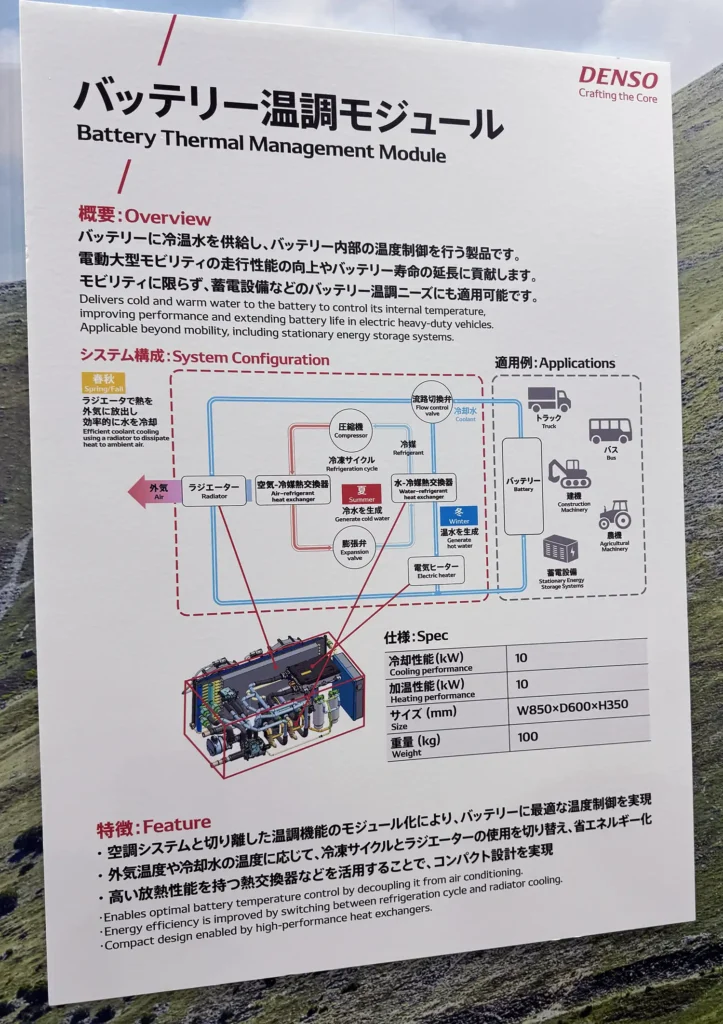
Precisely because these are commercial vehicles that travel long distances, reducing the energy consumed by the climate control system itself is a top priority. To address this challenge, this module employs a mechanism that seamlessly switches between two cooling modes—the “heat pump cycle” and the “radiator”—depending on the situation.
Of particular note is its operation during spring and fall, when the outside air is cool. During these seasons, the heat pump is kept running as little as possible, and energy-efficient cooling is achieved by utilizing “outside air” through the radiator. Only during periods of high load or in the summer does the system switch to DENSO’s proprietary high-efficiency heat pump cycle.This design philosophy—which intelligently harnesses the power of nature to minimize unnecessary power consumption to the absolute limit—truly shines.
Unparalleled “Vehicle Optimization” Capabilities Enabled by Independent Modularization
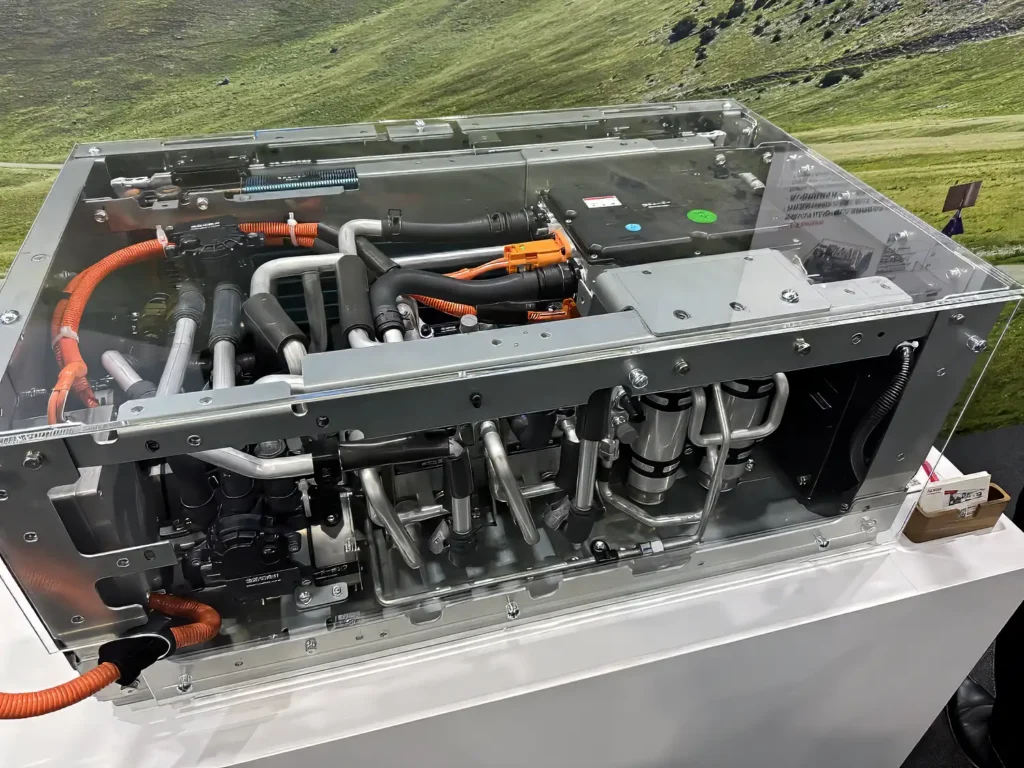
Furthermore, from a vehicle design perspective, the product’s superb packaging is particularly noteworthy. This product completely separates the functions necessary for battery temperature control—such as the heat pump, radiator, heater, and pump—from the cabin air conditioning system, organizing them into “independent modules.”
This makes it possible to flexibly optimize the placement and size of each unit to fit the vehicle’s frame and available space, without interfering in any way with the cabin’s climate control (driver comfort). The increased layout flexibility achieved through modularization is a major advantage that reduces the design burden on the vehicle manufacturer.
Overcoming Challenges of Weight and Size: Expanding from Commercial Vehicles to Passenger Cars
With its installation in the “Hino Profia Z FCV” marking the start, this module has already entered the practical application phase. Looking ahead, DENSO plans to focus its development and adoption efforts primarily on “commercial vehicles,” such as trucks and buses.
Behind this lies a real-world development challenge: the “weight” and “size” of the unit itself resulting from system integration. For this reason, the company is pursuing a strategy of first refining the unit’s extremely rigorous durability and reliability in large commercial vehicles—where there is a certain degree of flexibility regarding installation space and weight increases—and accumulating a track record and experience in actual field use.
Furthermore, drawing on the technology and know-how honed there, the company has overcome the challenges of making the product smaller and lighter, and is reportedly considering expanding into the “passenger car” market—a sector that will require stringent packaging standards in the future.
This product combines high cooling performance, precise energy-saving control, and ease of implementation as an independent module. It will first drive the market as a key component underpinning commercial EVs, and through steady technological advancement, it has the potential to eventually handle thermal management for the entire next-generation mobility sector, including passenger cars.
[Reporting, Writing, and Photography]
The mono-think Editors
A web media outlet that explores the cutting edge of Japan’s “manufacturing” and “infrastructure” from the perspective of active IT engineers, offering a unique perspective.