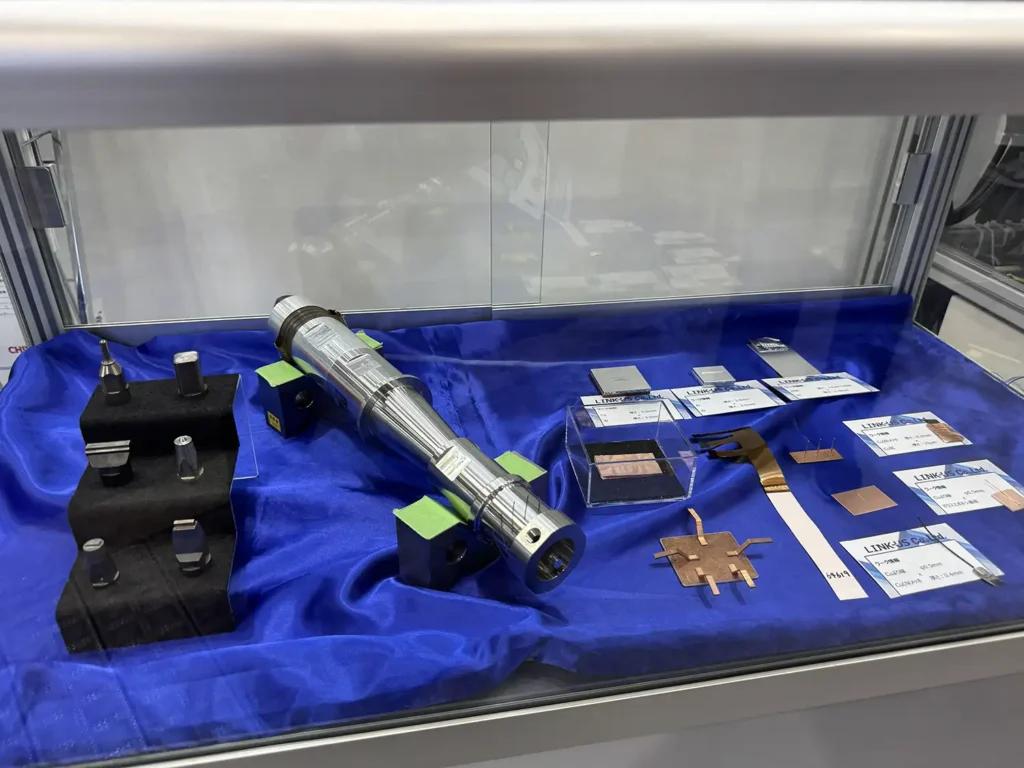
There is a technology that defies conventional wisdom regarding metal joining. It is the “Ultrasonic Composite Vibration Joining Technology” developed by LINK-US Co., Ltd.This approach, which firmly bonds metals using only ultrasonic energy without relying on heat-induced melting or liquid-phase joining, holds immense potential for next-generation manufacturing processes. This article explains its unique mechanism and the specific benefits it brings to manufacturing sites.
“Solid-State Bonding”: Dissipating Heat and Creating Strong Bonds at the Molecular Level
The greatest value of this technology lies in the fact that it “joins metals without melting them at all.”
While conventional welding typically involves melting metal with heat to join it, LINK-US’s technology relies solely on ultrasonic vibrations and pressure. By completely eliminating the processes of melting and liquid-phase joining, it is possible to fundamentally prevent heat-induced deformation and changes in material properties (degradation).As a result, it enables extremely strong, high-purity bonds at the molecular level—while preserving the materials’ inherent properties—even for dissimilar metals, which have traditionally been difficult to join, and for ultra-thin precision components that are sensitive to heat.
“Composite Vibration Trajectory” Combining Straight Lines and Twists
This “strong bond formed without heat” is made possible by the “composite vibration” mechanism developed exclusively by LINK-US.
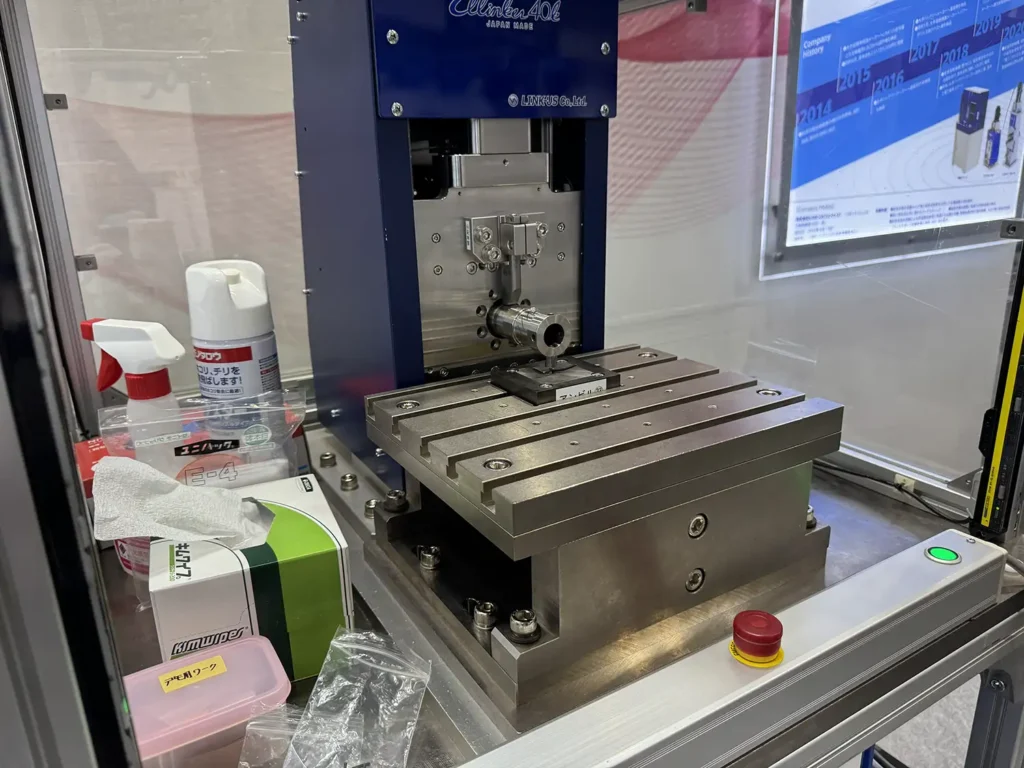
While conventional ultrasonic bonding relied solely on linear vibration, the company developed a specialized horn that adds “torsional vibration” to the linear vibration. As a result, the vibration trajectory becomes circular or elliptical.With linear vibration, a “bounce-back” inevitably occurs at the ends of the motion, resulting in the attenuation of vibrational energy and excessive physical damage to the workpiece (part). However, composite vibration with circular or elliptical trajectories does not involve such bounce-back.As a result, energy loss is extremely minimal, variations in strength due to the bonding direction are eliminated, and uniform bonding can be achieved in any direction.
Dramatic Improvement in Yield Through Reduced Damage and Energy Savings
This streamlined architecture offers significant business advantages in terms of both quality and cost management.
The smooth, non-rebound vibration minimizes damage to the workpiece edges and avoids heat effects around the joint, resulting in a dramatic improvement in yield during the manufacturing process. Furthermore, due to the high efficiency of energy transfer, this method enables joining with significantly greater energy savings compared to conventional methods.
In fields that demand extremely stringent quality control and environmental considerations—such as EV (electric vehicle) batteries, where demand is growing rapidly, and electronic devices that are becoming increasingly miniaturized—this “damage-free and reliable bonding technology” will likely become a powerful asset in determining the competitiveness of next-generation products.
[Reporting, Writing, and Photography]
The mono-think Editors
A web media outlet that explores the cutting edge of Japan’s “manufacturing” and “infrastructure” from the perspective of active IT engineers, offering a unique perspective.
[Research Cooperation & Related Links]
LINK-US
Chiyoda Trading
Adhesives & Joining EXPO