[Key Takeaways] Report on the 1st Entrance Ceremony of Mazda Automobile Service Technical College Kobe
- Date & Venue: April 9, 2026 / Kobe Mazda Headquarters Special Venue
- Overview: The inaugural ceremony of the new technical college established by Kobe Mazda, led by Principal Nobuhiro Yamamoto (former Mazda MX-5 / Roadster Program Manager), launching amid high expectations from the automotive industry.
- Key Focus: Exclusive coverage on the philosophy of automotive talent development and the industry-wide reception to this new initiative.
“If things continue this way, Japan’s car-dependent society will collapse”—driven by this intense sense of crisis, a local car dealer took action and built a vocational school from the ground up.
On April 9, 2026, a brand-new school opened its doors in the historic port city of Kobe: The “Mazda Automobile Service Technical College Kobe” (nicknamed “Mastec Kobe”).We, the “MONO-THINK” reporting team, covered this momentous first step taken by the next generation of essential workers who will fundamentally support Japan’s “manufacturing” and “infrastructure.”
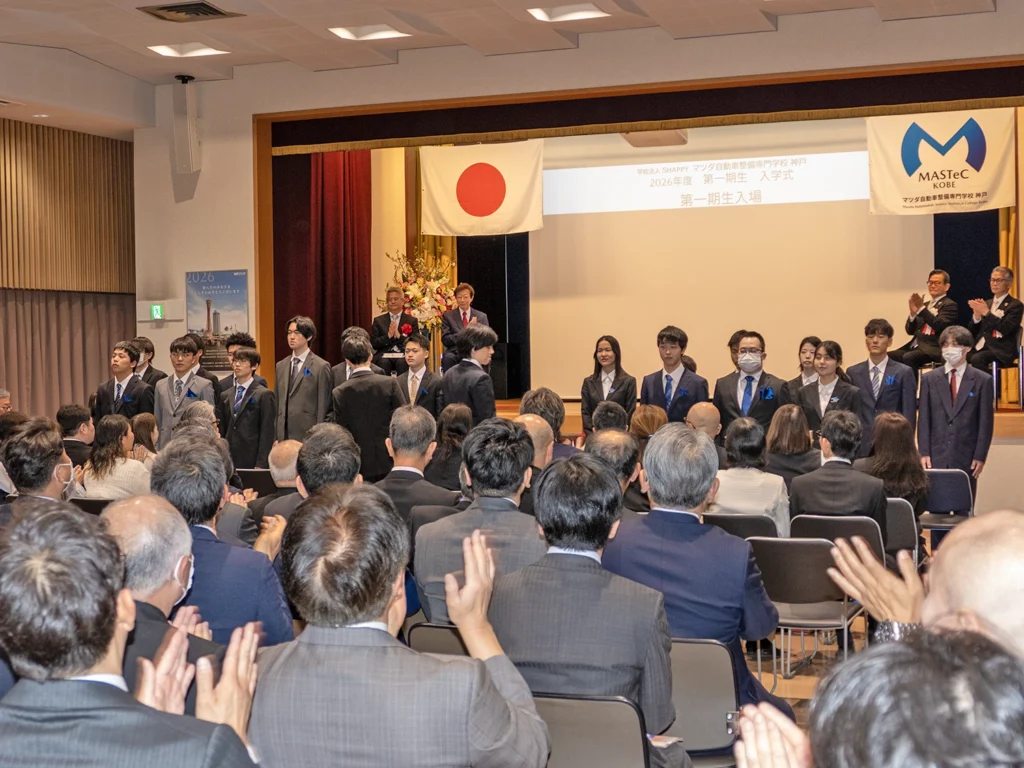
A diverse group of “pioneers” gathered in a hall that has stood the test of time for 64 years
The venue for the entrance ceremony was a historic hall built 64 years ago by Shigeo Hashimoto, the founder of Kobe Mazda, who believed that “to welcome outstanding talent, one needs a venue befitting such individuals.” As the hall’s imposing doors swung open, the 21 students of the first graduating class, dressed in brand-new suits, filed in.
The data on the group’s composition is quite interesting. Among the fresh-faced young people who had just graduated from high school, there were four working adults who had entered the program to “return to school” after having already entered the workforce. Of the 18 men, there were also three women. Furthermore, five young people had gathered in Kobe not only from within Hyogo Prefecture but also from outside the prefecture.
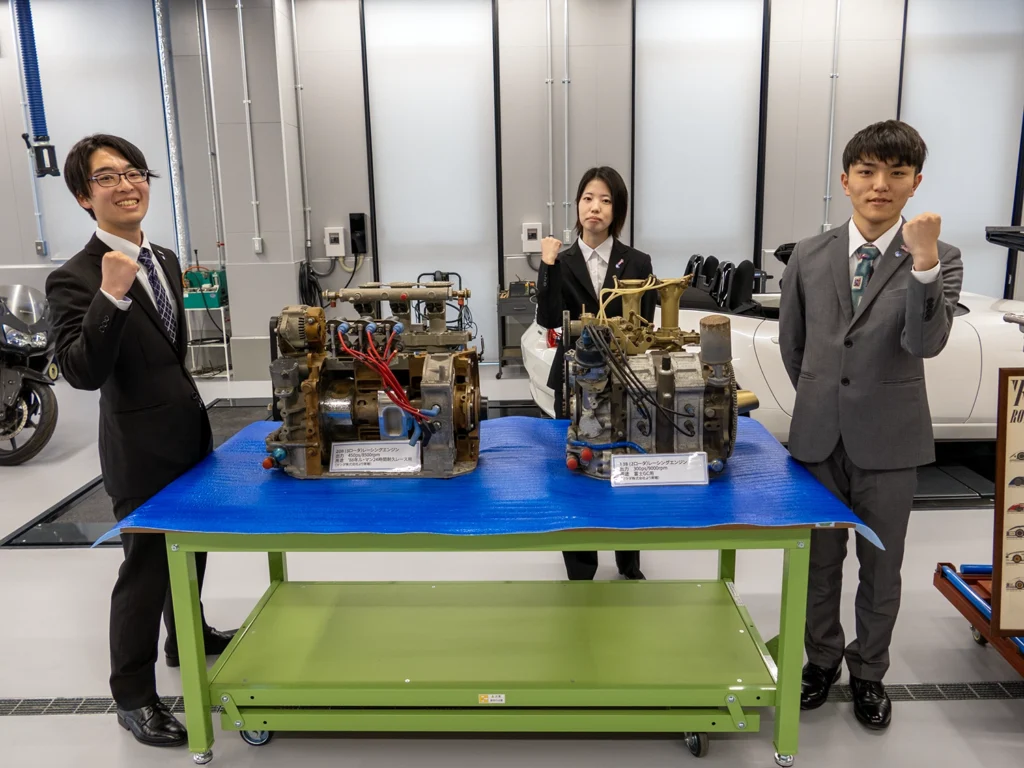
And what’s most surprising of all is that 10 of the 21 participants are either “student employees” at Mazda dealerships—earning a salary while they study—or recipients of scholarships. The group here isn’t simply a gathering of young people who “like cars.”They are a diverse group of passionate pioneers who, having received “serious investment in human capital” from the automotive industry, have chosen of their own volition to leap to the forefront of the future.
It's sure to get car enthusiasts' hearts racing! An exciting learning experience created by a "legendary engineer"
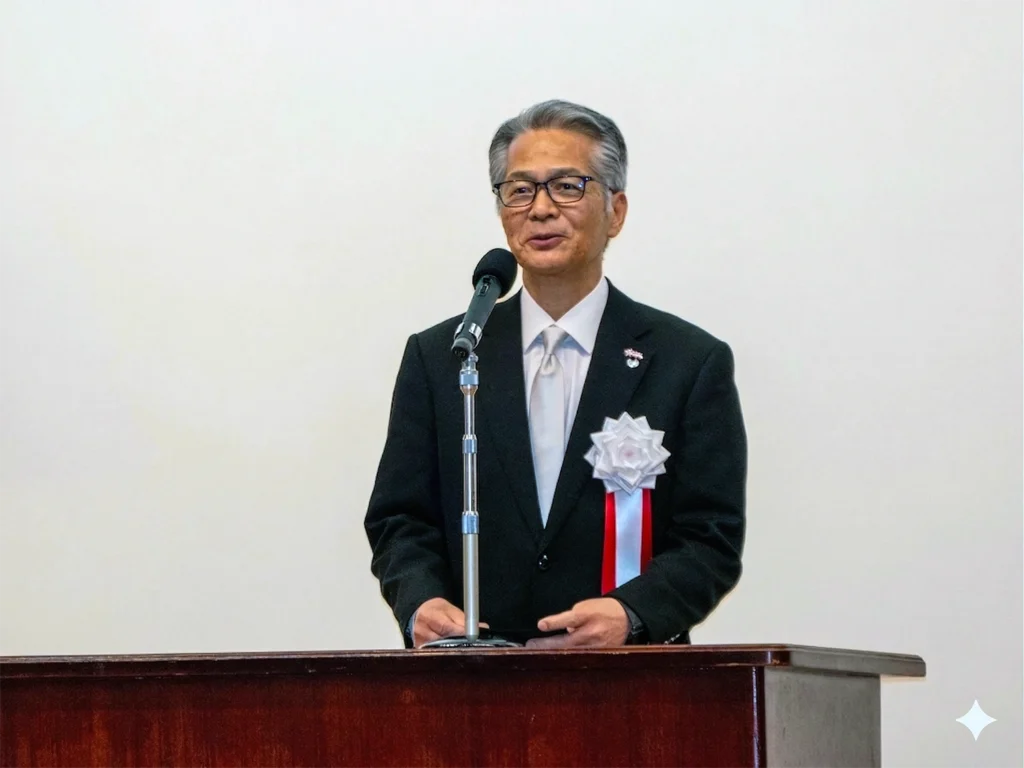
“Today is the day your new engine kicks off.”
It was Mr. Nobuhiro Yamamoto, who has just been appointed principal of our school, who addressed the new students with such warmth. Having served as the lead engineer on the development of Mazda’s rotary engine and the “Roadster”—a legendary car beloved around the world—he is truly a “legendary engineer” who embodies the Mazda spirit.
When people think of automotive repair schools, some may still hold onto the outdated image of students getting covered in oil while being drilled in technical skills in the demanding world of skilled trades. However, the educational curriculum developed by Principal Yamamoto is designed to prioritize the “excitement” of today’s youth above all else.
“You can’t stay motivated if it’s all classroom learning. First, you need to get hands-on with a real car and drive a Roadster. I want them to start with that fundamental experience of realizing, ‘Cars are fun!'”
Furthermore, the curriculum reportedly includes participation in Mazda’s renowned “motorsports” programs, as well as driving experiences on the track. Rather than simply memorizing the structure of parts, students immerse themselves in the excitement of motorsports and experience the “joy of driving” firsthand. For young car enthusiasts, there’s probably no environment that gets their blood pumping quite like this.
The Passionate Enthusiasm of Freshmen That Blows Away the Trend of Young People Turning Away from Cars
It’s been a long time since people started talking about “young people turning away from cars,” but when you hear the firsthand accounts of the first-year students I met on the ground, that notion just flies out the window.
One male student told us with a twinkle in his eye, “I’m really happy to be able to study using Mazda cars. Someday, I’d love to get my hands on a Eunos Cosmo or a three-rotor engine.”
Another male student has an even more ambitious goal. “At school, I want to thoroughly study how to disassemble and reassemble engines. My dream for the future is to drive a first-generation Cosmo Sport and keep it running through my own maintenance work.”
On the other hand, one female student shared her warm feelings for her “beloved car,” which is an integral part of her daily life. Having enrolled after changing her career path, she told us this, her words tinged with a touch of anxiety and great anticipation. “I want to be able to fix the engine of my beloved Atenza sedan myself. I hope that way, I’ll be able to keep driving it for about 10 more years.”
Those who are captivated by the romance of classic cars from decades past and strive to carry on their legacy. And those who, with their own hands, seek to cherish and preserve the cars that enrich their lives for years to come.
Although their paths may differ, the deep passion for cars and the spirit of inquiry they display stir the hearts of the older generation who once drove Japan’s “monozukuri” (craftsmanship). What kind of professionals will they grow into, nurtured by this pure, initial impulse of “passion” in the fertile ground that is Mastec Kobe?
An educational environment that gives parents peace of mind. Mazda’s “supportive” mindset—not just “fixing cars,” but “nurturing people.”
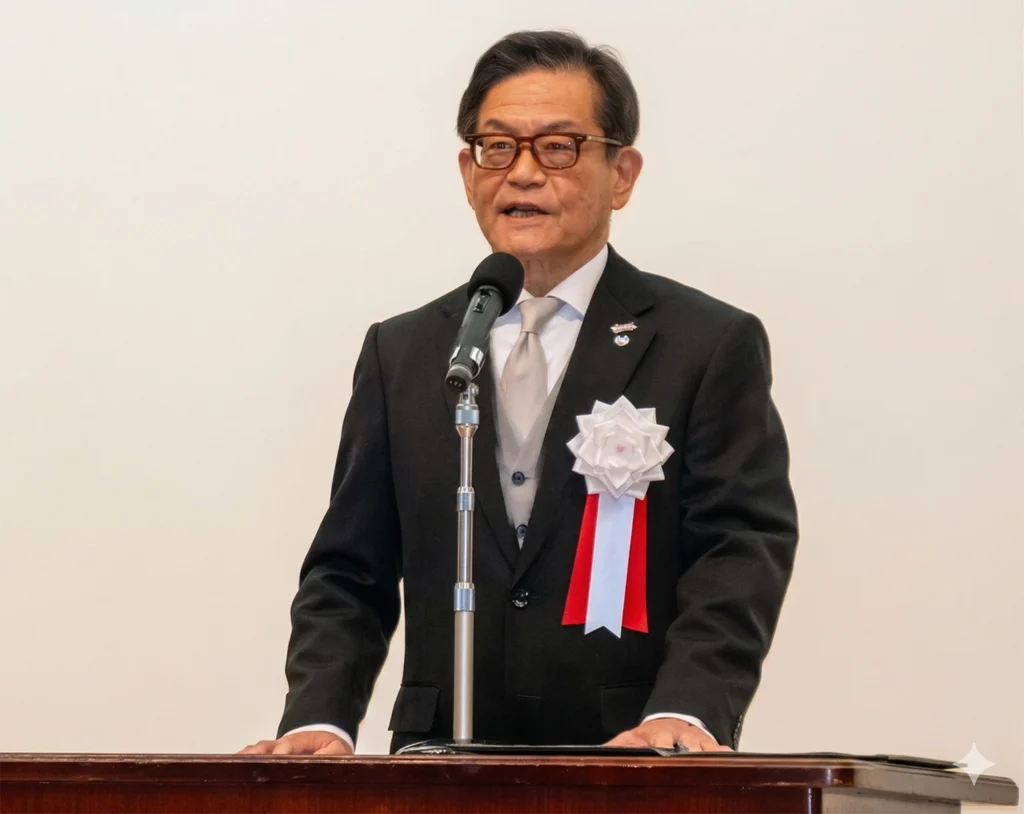
Sending our beloved children off as the “first graduating class” of this newly established school—while filled with anticipation, parents surely also felt a fair amount of anxiety. However, after hearing the remarks from the school’s top leadership at the ceremony, that anxiety must have turned into a genuine sense of “reassurance” and “trust.”
Satoru Hashimoto, Chairman of the 5HAPPY Educational Foundation—the organization that operates Mastec Kobe—bowed deeply and firmly toward the parents’ section and made the following pledge: “We will take responsibility for your precious sons and daughters and raise them to become upstanding members of society.”
They are absolutely determined not to turn the school into a mere “training center” that simply drills students in automotive maintenance skills. This resolve was clearly reflected in the following message from Chairman Hashimoto to the incoming students.
“Working means being of service to others and contributing to society. Now is the time for you to give back to society the ‘love’ your families have showered upon you. I hope you will view your two years at this school as a time to prepare for that.”
Rather than heavy-handed philosophical musings, it’s a wonderfully warm and emotional expression: “returning love.” This reflects an attitude that prioritizes, above all else, the “mindset” of how to live as a human being—even before engaging with the physical machine that is a car.
"Creating the Right Answer Together" Without Fear of Failure: The Passionate Determination of Faculty and Staff
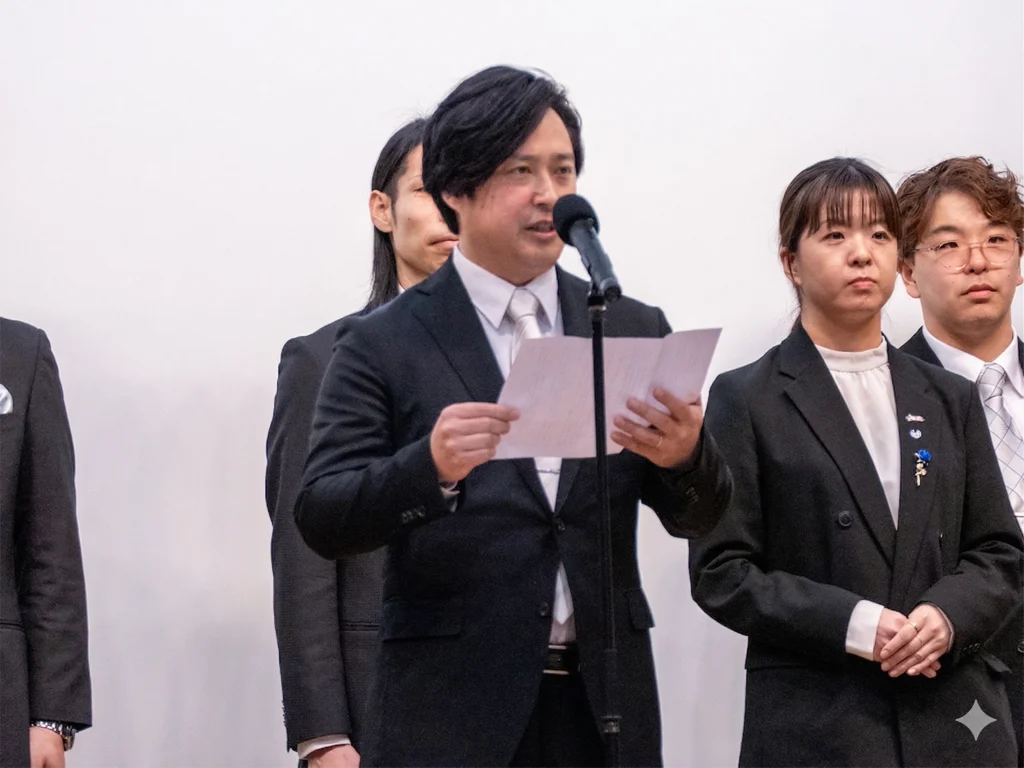
This philosophy of “human education” has taken deep root among the faculty and staff who work directly with students on the ground. The welcoming remarks delivered by Professor Toba on behalf of the faculty and staff resonated deeply with us members of the media, who had come from outside the industry to cover the event.
“In the realm of uncharted territory, where no one has gone before, there is no need to fear failure. Rather than simply providing the ‘right answers,’ we—the faculty and staff—will wrestle with these challenges alongside you, learn together, and give it our all so that we ourselves can become the ‘right answers.'”
For today’s young people, an environment where “correct answers” are unilaterally imposed from above feels stifling.Especially now, as the automotive industry itself is undergoing a once-in-a-century transformation, there is no guarantee that “past solutions” will continue to work in the future. That is precisely why a flat, collaborative approach—one in which we “search for and create the right answers together” as we move toward an unknown future—can be considered the ideal model for education going forward.
Mr. Toba described the job of an auto mechanic as “an incredibly proud profession that creates the ‘Five Happies’: my own happiness, my family’s happiness, my customers’ happiness, my colleagues’ happiness, and the happiness of the local community.”
“Craftsmanship begins with character.” As this age-old saying suggests, true technical skill can only flourish when grounded in rich humanity. The ceremony proved that Mastec Kobe, this new school, possesses an exceptionally sincere and nurturing environment dedicated to fostering “independent individuals” before they become engineers.
Protecting Society’s Lifelines: Pride and Future Prospects as the Next Generation of “Essential Workers”
The automotive industry is currently undergoing a once-in-a-century transformation. With the ongoing advancements in AI and the rise of electric vehicles (EVs) and autonomous driving technology, some young people and their parents may be wondering, “What does the future hold for the profession of automotive technician?”
However, the answer is clear. Far from declining, the value of mechanics will only grow in importance from here on out.
Mr. Tada, Section Chief at the Ministry of Land, Infrastructure, Transport and Tourism, who took the stage as a guest of honor at the ceremony, described future automotive technicians as “national treasures.” Additionally, Kobe Mayor Hisamoto emphasized that the city’s infrastructure itself—including public buses, which serve as the citizens’ primary means of transportation, and trucks that support logistics—is sustained by their technical expertise.Furthermore, Mr. Kagome, President of Mazda Motor Corporation, delivered a powerful message about “supporting the everyday life we take for granted.”
No matter how digitized a car becomes or how advanced its AI may be, it cannot escape the “real-world laws of physics”—the fact that tires wear down, suspensions move, and the vehicle carries people as it drives.Advanced IT knowledge combined with the solid skills to repair physical hardware—the next generation of automotive technicians who possess both of these qualities will become the ultimate “essential workers” (professions indispensable to society), a role that AI can never replace.
A message of support that transcends brand boundaries. An overwhelming flood of “congratulatory messages” filled the screen.
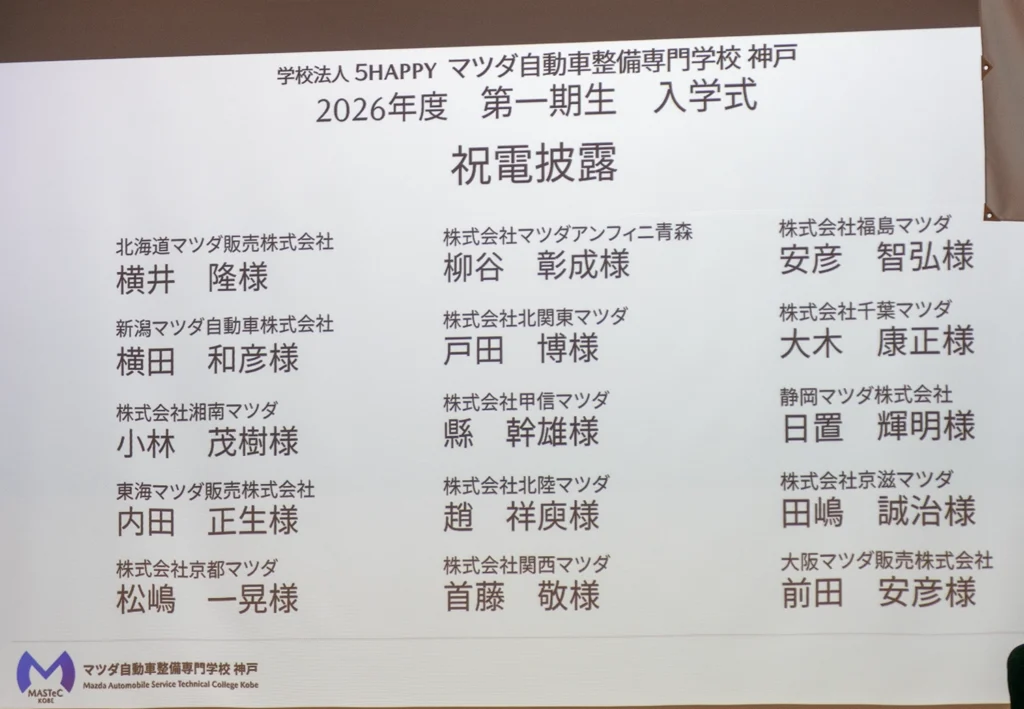
Just how much society demands of them and expects from them. This was most vividly and on an overwhelming scale evident during the segment toward the end of the ceremony when the guests were introduced and congratulatory messages were read aloud.
As we looked at the list of congratulatory messages displayed on the screen, our reporting team couldn’t help but gasp.
Not only were Mazda dealerships—which cover the entire country from Hokkaido to Kyushu—represented, but what surprised me was the long list of dealerships that had “completely transcended manufacturer boundaries,” including Toyota, Nissan, Honda, Mitsubishi, Suzuki, and Daihatsu.Furthermore, congratulatory messages from every conceivable organization—ranging from the JAF (Japan Automobile Federation) and Autobacs to numerous megabanks, regional banks representing each prefecture, major insurance companies, tire manufacturers, and even a local bus company in Kobe—filled the screen.
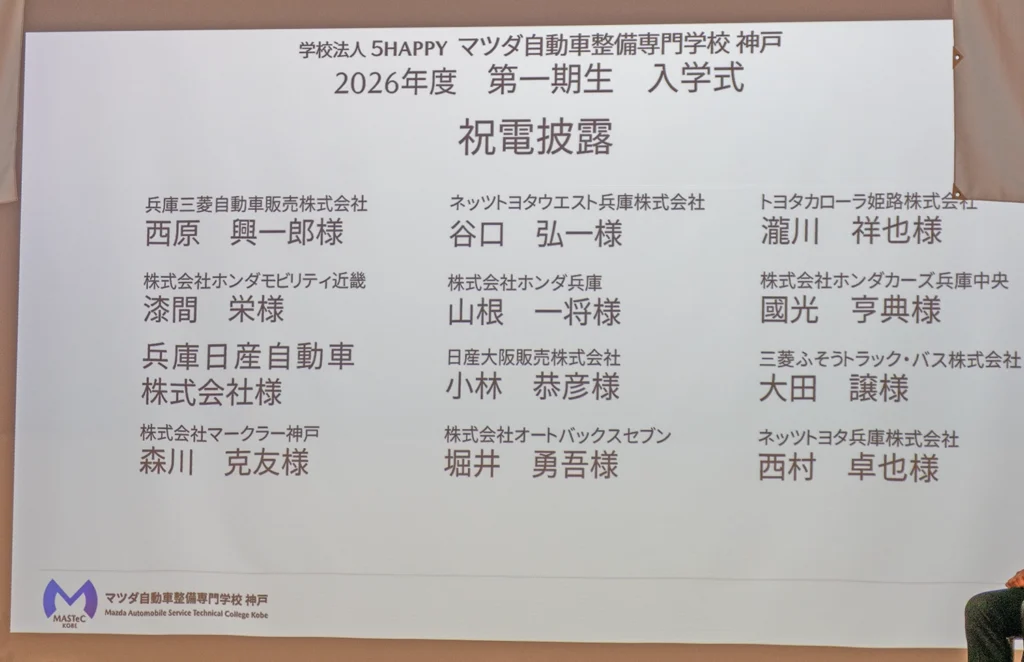
This was not merely a courtesy congratulatory telegram. It was a passionate show of support sent by the entire Japanese industrial sector—which faces the common challenge of a severe shortage of mechanics—as it joined hands, transcending the boundaries of manufacturers and competitive rivalries, to say, “To our new colleagues who will fundamentally support Japan’s automotive society and infrastructure: we’re counting on you.”
What they are about to dive into is not just some ordinary local repair shop. It is the very heart of a “massive manufacturing network” that is firmly intertwined with every industry in Japan—including finance, insurance, logistics, and infrastructure.
Let's Make History Together — 21 Pioneers Creating History Together

“With the pride and determination that come with being part of the first graduating class, we will forge our own future with our own hands.”
At the conclusion of the ceremony, Mr. Watanabe, who took the stage on behalf of the incoming students, recited the oath in a clear, strong voice, despite looking nervous.They have no senior students to look up to as role models, and the school has no established traditions yet. But precisely because of this, rather than simply following a predetermined path, they can become “the very first page of Mastec Kobe’s history” themselves.
Born out of the adults’ sense of crisis that “the car-dependent society will collapse if things continue as they are,” and having overcome countless obstacles to finally open its doors, this school is imbued with the “pioneering” DNA that creates something from nothing. The 21 students gathered here today, dressed in their brand-new suits, are also fine “pioneers” who have inherited that DNA.
I’d like to conclude by sharing once more the words that Principal Yamamoto, a legendary engineer, addressed to the young people at the beginning of the ceremony.
"Let's make history together"
Today, their new engine roared to life. With a pure love for cars and a sense of pride in supporting social infrastructure in their hearts, what kind of history will they go on to create? We look forward to continuing to watch these young pioneers’ challenges with excitement.
[Reporting, Writing, and Photography]
The mono-think Editors
A web media outlet that explores the cutting edge of Japan’s “manufacturing” and “infrastructure” from the perspective of active IT engineers, offering a unique perspective.
[Research Cooperation & Related Links]
Mazda Automobile Service Technical College Kobe (Mastec Kobe)
Kobe Mazda Co Ltd.