“Foreign Particle and Dust Control”—an ever-present challenge on the manufacturing floor.At the recent 14th High-Performance Film Exhibition [Osaka], we encountered a core technology that goes beyond mere cleaning to logically eliminate and manage microscopic dust particles at the microscopic level. In this article, we explore the philosophy behind Osada Corporation’s cleaning technology and the business benefits it delivers.
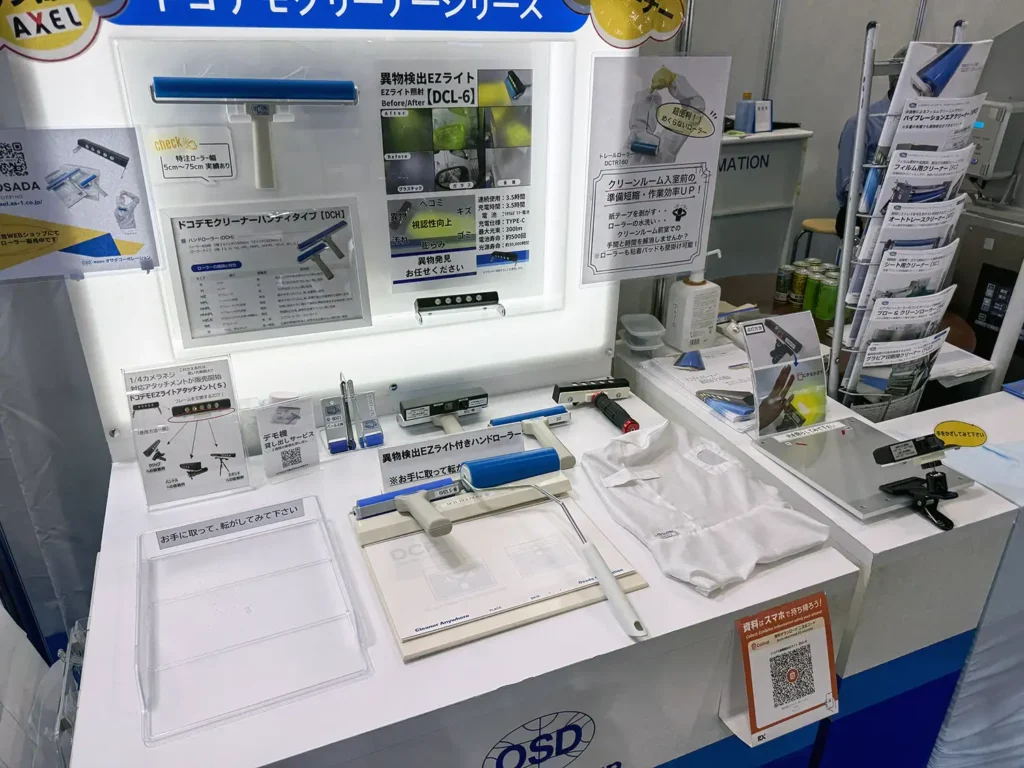
1. [Core Technology] “Reliably Capture and 100% Reset”: The Transfer and Adsorption Mechanism
Osada Corporation’s core technology lies in its “two-stage transfer and adsorption architecture,” which reliably captures microscopic dust particles invisible to the naked eye and maintains a clean environment.
A special rubber roller that adheres closely to the target surface efficiently captures dust, which is then immediately collected (transferred) by the adhesive tape roller behind it. This mechanism ensures that the surface in contact with the target object is always kept clean.Furthermore, when the adhesive tape becomes saturated, simply peeling back one layer of the multi-layer sheet fully restores its initial adhesion performance. This streamlined design allows anyone to “reset” performance in an instant, regardless of their level of experience on the job.
2. [Key Point] Logical Consistency as a “Debugging Tool” in the Field
What sets this technology apart from ordinary cleaners is that it treats dust not as “something to be simply discarded,” but as “data (history).”
By tracing the history of dust collected on adhesive tape, it becomes possible to conduct a root cause analysis to determine “at which stage of the process foreign matter was introduced.” This is exactly the same approach used in system development, where error logs are analyzed to fundamentally fix bugs in tangled code. The true value of this technology lies in the fact that it provides managers with logical evidence to “cut off the source” of problems, rather than simply repeating symptomatic cleaning measures.
3. [Bringing Technology to Life] A Product Line That Covers Both Production Lines and Workstations
This shared core technology has been optimally incorporated into products to meet the needs of the field.
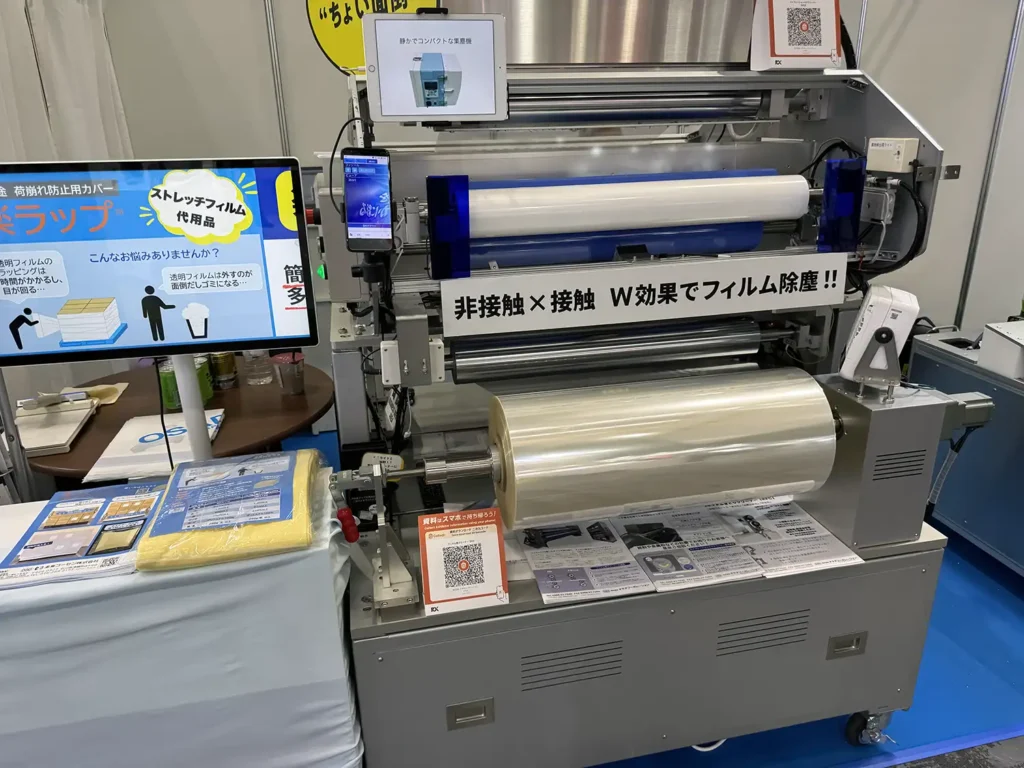
In-Line Automatic Type: “FC” Film Cleaner
A system that can be retrofitted to existing automated production lines. It continuously removes dust inline while smoothly conveying substrates—such as thin films, soft materials, and metal foils—that were prone to tangling with conventional rollers.
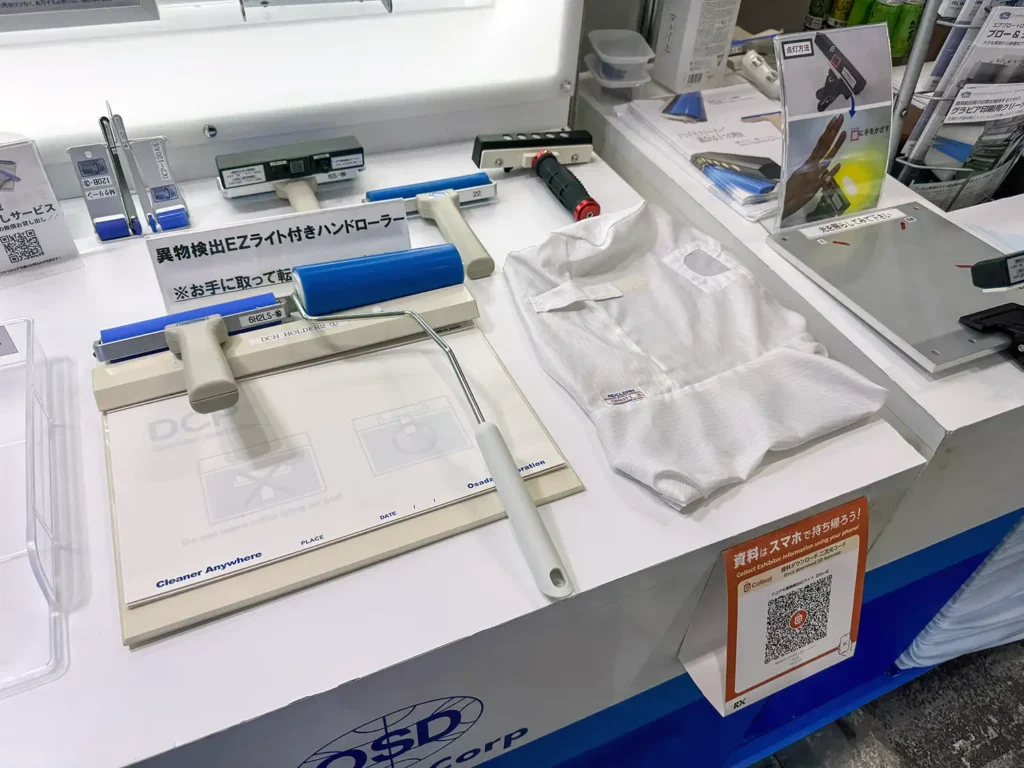
Manual Spot Type: Dokodemo Cleaner “DCH” × Foreign Object Detection EZ Light
This handheld roller is equipped with special infrared and LED technology (EZ Light). It “visualizes” minute foreign objects on the work surface that were previously invisible, allowing users to address them accurately and reliably on the spot—a tool that enhances on-site operational flexibility.
4. [Impact from a Business and Management Perspective] Optimizing Return on Investment
Even without making massive hardware investments to upgrade the cleanroom classification of the entire factory, it may be possible to achieve dramatic improvements in yield by “incorporating technology” in specific areas of the process. This can be considered an extremely practical tool for identifying the optimal solution for allocating limited management resources.
[Reporting, Writing, and Photography]
The mono-think Editors
A web media outlet that explores the cutting edge of Japan’s “manufacturing” and “infrastructure” from the perspective of active IT engineers, offering a unique perspective.
[Research Cooperation & Related Links]
Osada Corporation, Inc.
The 14th High-Performance Film Exhibition [Osaka] *This exhibition is a trade show for industry professionals. Admission is not open to the general public.