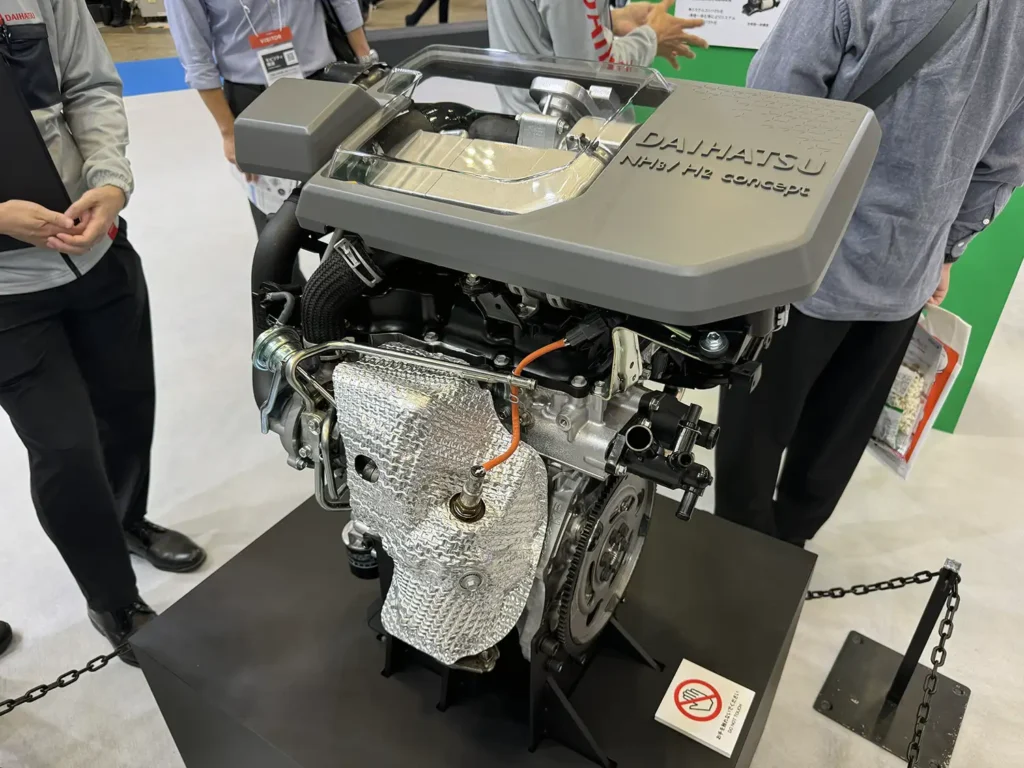
At Japan Mobility Show Bizweek 2026, Daihatsu Motor Co., Ltd. exhibited a prototype of an “ammonia/hydrogen co-combustion engine” as a next-generation carbon-neutral powertrain. This article explains the technical breakthroughs presented by this engine and the challenges it faces toward mass production.
Why Co-Combust “Hydrogen” and “Ammonia”?
Ammonia does not emit CO2 when burned, making it a strong candidate for carbon-neutral fuels. However, when used as a standalone fuel, it faces a critical combustion issue: it is extremely difficult to burn (low flammability).
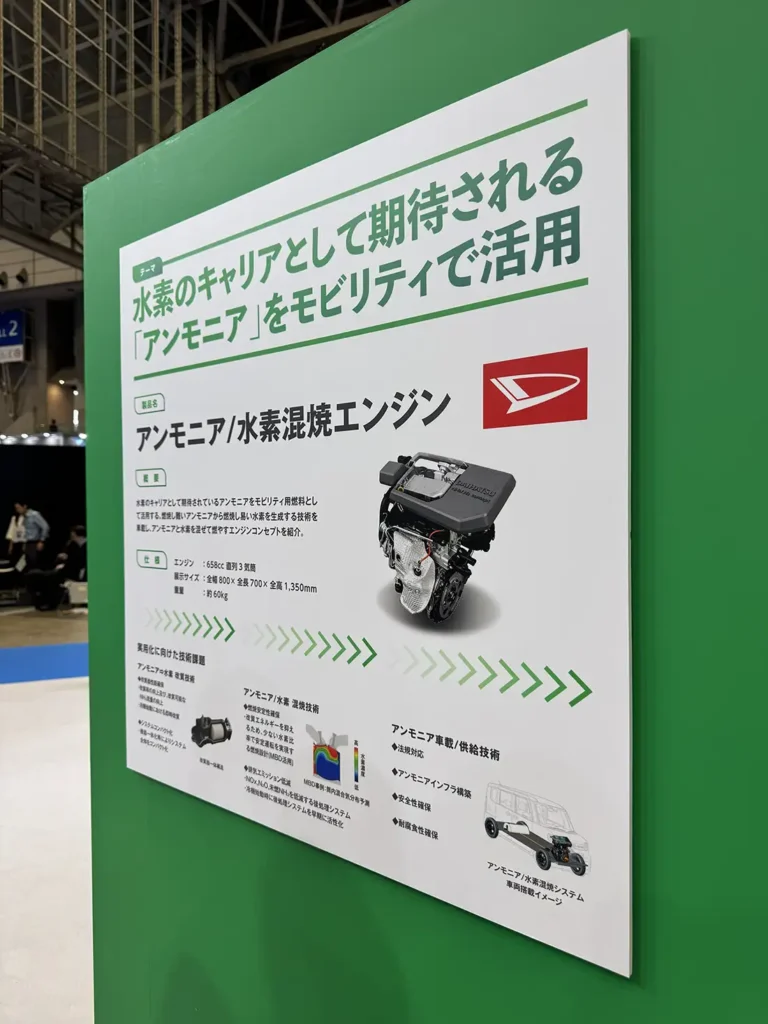
To address this challenge, Daihatsu adopted an approach where a portion of the on-board ammonia is converted into “hydrogen,” and the mixture of ammonia and hydrogen is combusted within the engine. By using highly combustible hydrogen as an ignition promoter, the system compensates for ammonia’s low flammability, aiming to achieve clean and stable combustion. Although currently in the research phase, development is proceeding with the initial goal of securing an output equivalent to that of existing gasoline engines.
The Advantage of “Energy Density” Over Pure Hydrogen Engines
While hydrogen itself is garnering attention as a next-generation fuel, the primary reason Daihatsu deliberately chose ammonia as the base fuel is its “high energy density.”
To extend the cruising range using hydrogen, it must be stored either as a gas under ultra-high pressure or as a cryogenic liquid. In either case, larger fuel tanks and specialized storage facilities are required. In contrast, because ammonia has a higher energy density than hydrogen, it allows for an extended cruising range even with a relatively small fuel tank. Although the tank capacity must still be larger than that of existing gasoline vehicles, this advantage holds significant technical meaning for compact mobility vehicles, which face severe packaging constraints.
Addressing “Corrosiveness” and Material Selection Challenges
While the approach to combustion control is becoming established, physical and chemical hurdles remain for mass production. The biggest challenges are dealing with the characteristic odor of ammonia and its “corrosiveness” to automotive components.
To overcome these issues, reliable leak prevention (sealing technology) and the appropriate selection of materials for fuel lines and tanks will be crucial moving forward. Furthermore, collaboration with companies responsible for ammonia supply infrastructure will be essential for future demonstration tests and societal implementation.
The “ammonia/hydrogen co-combustion engine” achieves carbon neutrality while leveraging the technical assets of internal combustion engines. We will continue to closely watch the forefront of this research and development to see how it overcomes the barriers of low flammability and corrosiveness to establish itself as a viable alternative to gasoline powertrains.
[Reporting, Writing, and Photography]
The mono-think Editors
A web media outlet that explores the cutting edge of Japan’s “manufacturing” and “infrastructure” from the perspective of active IT engineers, offering a unique perspective.
[Research Cooperation & Related Links]
Daihatsu Motor Co., Ltd.
Japan Mobility Show, Bizweek 2026