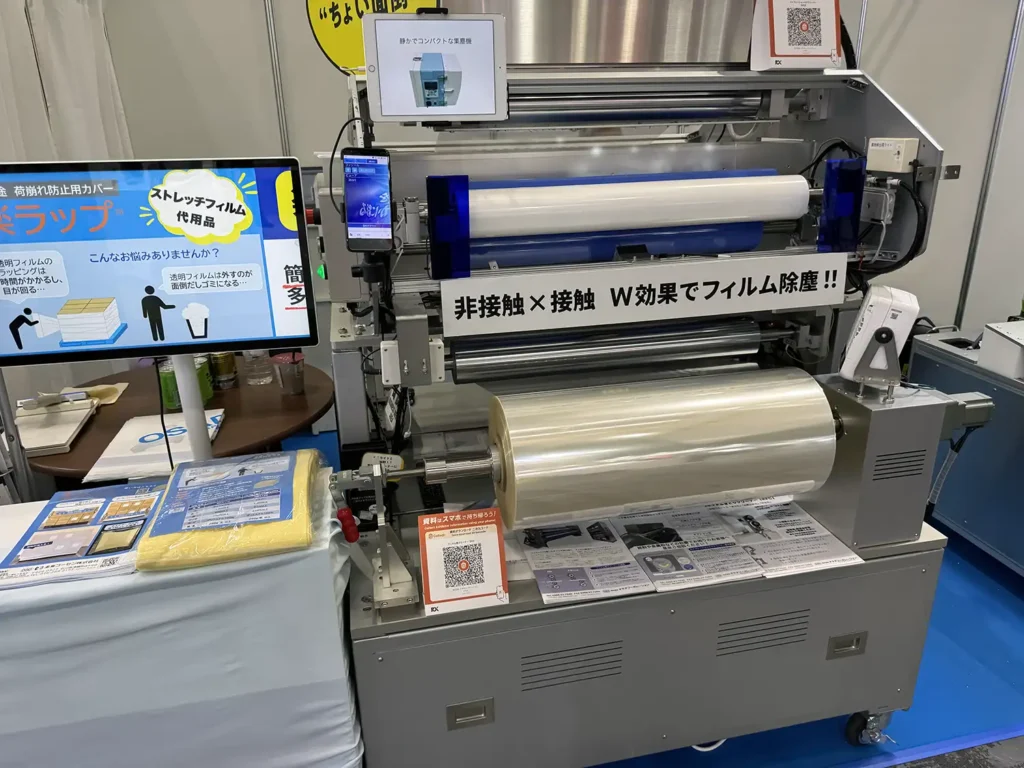
Transparent stretch film is used as a matter of course in logistics operations. However, risks of macro-level supply chain disruptions—such as the surge in naphtha prices driven by escalating tensions in the Middle East—are quietly sounding the alarm on this “disposable norm.”In this article, we’ll explore tips for building robust logistics operations that aren’t at the mercy of external conditions, drawing insights from “Raku Wrap,” a cargo-securing cover developed by Mirai Kosen Co., Ltd.
1. [Product Overview] A dedicated cover designed to eliminate the need for plastic wrap—simply slip it on and you’re done.
“Raku Wrap” is a one-piece knitted cover made of 100% polyester designed to prevent cargo from shifting on pallets.
Unlike conventional stretch film, there’s no need to wrap it around multiple times; installation is complete simply by slipping it over the top (or bottom) of the package. Its special knitted structure—which has no seams—provides excellent elasticity and fits snugly around the shape of the package, effectively preventing the contents from shifting.Its most notable feature is that it is “reusable,” meaning it generates absolutely no plastic waste, unlike stretch film.
2. [Key Points] A “Mono-Think” Perspective
What caught my attention about this product was not simply that it is an “eco-friendly product,” but rather that it is exceptionally effective as a tool that does not rely on external conditions.
Continuing to rely on conventional petroleum-based stretch film means constantly exposing the business to the vulnerability of price fluctuation risks. Furthermore, the repetitive actions of “wrapping,” “unwrapping,” and “disposing of” the film each time lead to a continuous accumulation of invisible labor costs (technical debt) on the shop floor. Replacing these materials with Rakurap represents a highly logical approach that fundamentally rethinks this “logistics architecture based on the premise of single-use,” converts variable costs into fixed costs, and standardizes operations.
3. [Impact from a Management Perspective] Improving Resilience and Agility on the Front Lines
The secondary benefits are also worth noting. If you need to remove only a portion of the contents, with plastic wrap you’d have to tear it open and rewrap it, but with Rakurap, you can access the contents simply by “peeling back a small section.” This significantly improves operational agility on-site.
Furthermore, the fact that it is weather-resistant and suitable for outdoor storage, and that it serves as a measure to prevent items from falling off storage racks during earthquakes, is reassuring from a BCP (Business Continuity Plan) perspective. It hedges against macro-level procurement risks while dramatically reducing the micro-level workload on-site.In these unpredictable times, it serves as a sensible “protective measure” to prevent the wasteful drain of unnecessary operating costs.
[Reporting, Writing, and Photography]
The mono-think Editors
A web media outlet that explores the cutting edge of Japan’s “manufacturing” and “infrastructure” from the perspective of active IT engineers, offering a unique perspective.
[Research Cooperation & Related Links]
Osada Corporation, Inc.
The 14th High-Performance Film Exhibition [Osaka] *This exhibition is a trade show for industry professionals. Admission is not open to the general public.