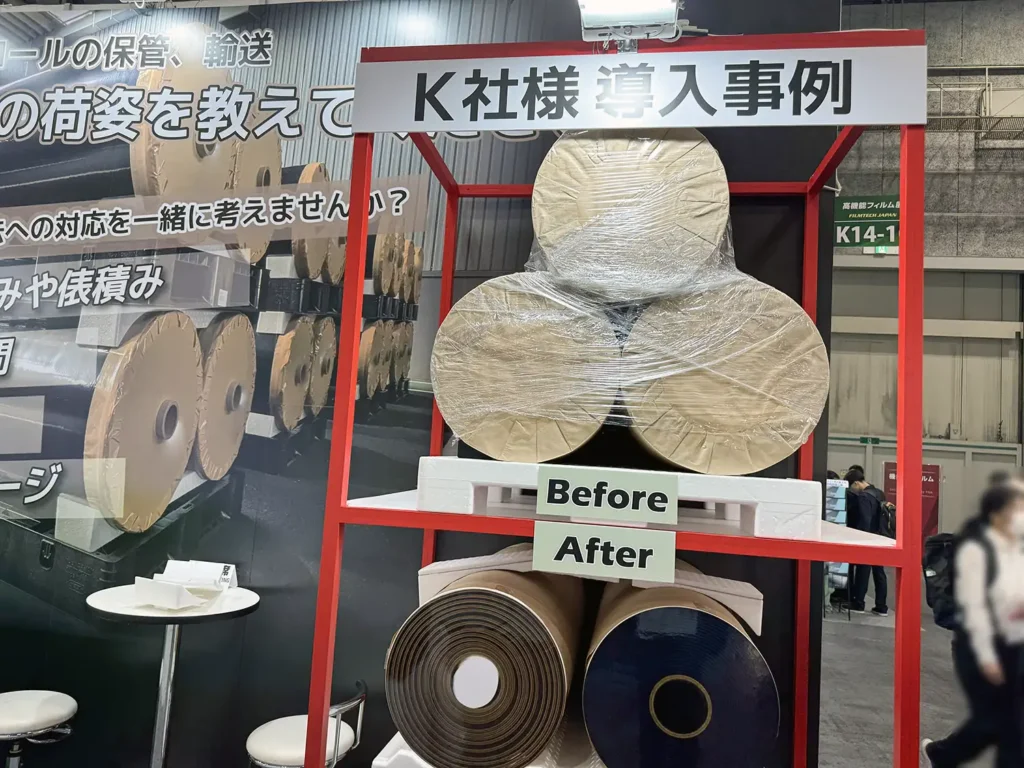
Roll-form products such as film and sheet materials. When storing these items in a warehouse, “deformation” or “crushing” of the lower layers caused by their own weight has long been treated as a “necessary evil” that must be tolerated to some extent. However, there is an approach that completely overturns this conventional wisdom.In this article, we’ll explore the innovation in storage quality and the business impact brought about by the “EPS Roll Holder Pallet” from Toho Kogyo Co., Ltd., a pioneer in expanded polystyrene (EPS).
1. [Product Overview] Pallets with a “custom design” that adapts the infrastructure to the object
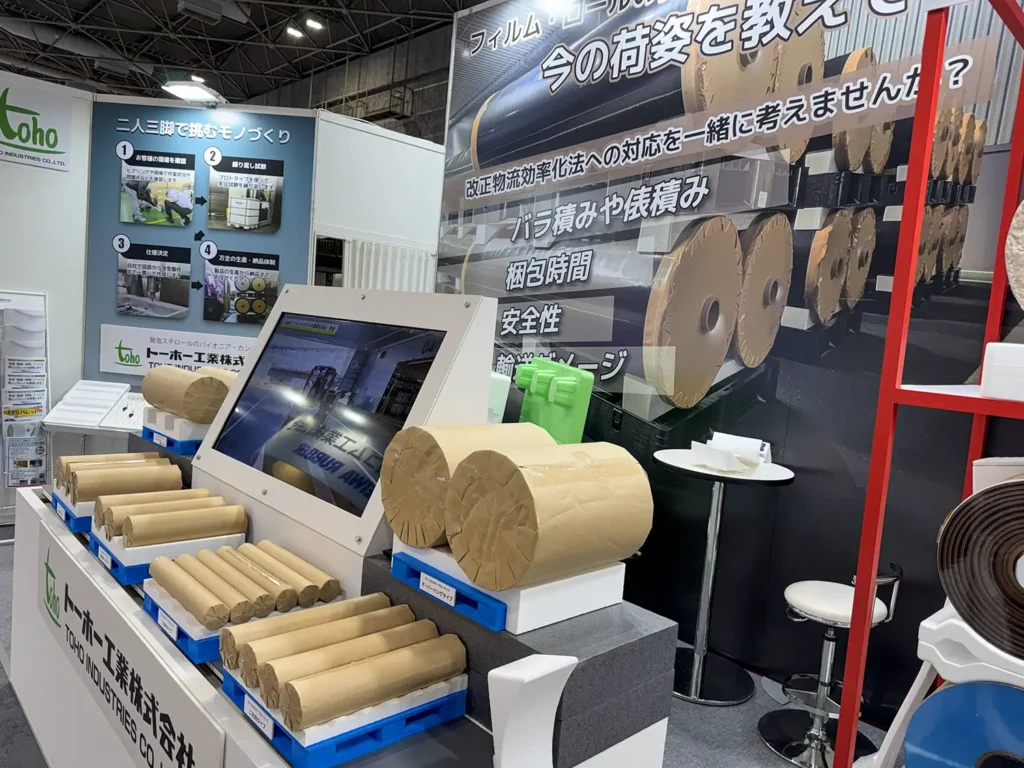
The “EPS Roll Holder Pallet” developed by Toho Industries is a specialized pallet that takes advantage of the workability of EPS (expanded polystyrene) to allow for flexible customization of its shape to match the curved surfaces of the rolled products being loaded.
With conventional flat wooden or plastic pallets, when cylindrical products are placed on them, the contact points with the pallet become “lines,” causing the product’s weight—hundreds of kilograms—to be concentrated locally at those points. This is what causes deformation and crushing.The EPS roll holder pallet is molded to fit snugly against the curved surface of the roll, transforming the contact point into a “surface” and distributing the load evenly. It is a well-designed structure that holds the load gently yet securely.
2. [Key Points] A “Mono-Think” Perspective
What struck me as most noteworthy during this reporting was the reality that the construction site is “reluctantly cutting off and discarding” the bottom few meters of the structure, which had lost its shape due to its own weight.
This is not a manufacturing defect, but rather an unjustifiable loss that occurs simply by “leaving the product on a flat surface.” In today’s manufacturing environment, where every form of waste is being eliminated and sustainability is under intense scrutiny, this “inevitable waste caused by storage” is a silent killer that cannot be overlooked from a business perspective.
By replacing the EPS roll holders with pallets—and adapting the infrastructure (pallets) to fit the shape of the items being transported—this approach eliminates waste entirely at its source.This approach sincerely addresses an unsolved problem that the industry had previously given up on, claiming there were “no specifications”—using technology and ingenuity. This, indeed, represents the true essence of “Japanese-brand” manufacturing that does not ignore the customer’s pain points.
3. [Impact from a Business and Management Perspective] Optimizing Logistics in Anticipation of the 2024 Problem
Eliminating waste is not the only benefit. By using EPS, an ultra-lightweight material, the weight of the pallets themselves can be dramatically reduced. This lowers the total weight of the load, which directly leads to improved fuel efficiency, increased loading efficiency, and better working conditions.
As the “2024 Problem” in the logistics industry becomes increasingly serious, improving the efficiency of cargo handling operations and working conditions has become an urgent priority.By eliminating the compromise of “misalignment”—which for many years has quietly eroded profits and environmental resources in the corners of warehouses—and contributing to the optimization of the entire logistics system, this pallet is poised to become a powerful tool in building the next-generation supply chain.
[Reporting, Writing, and Photography]
The mono-think Editors
A web media outlet that explores the cutting edge of Japan’s “manufacturing” and “infrastructure” from the perspective of active IT engineers, offering a unique perspective.
[Research Cooperation & Related Links]
Toho Kogyo Co., Ltd.
The 14th High-Performance Film Exhibition [Osaka] *This exhibition is a trade show for industry professionals. Admission is not open to the general public.