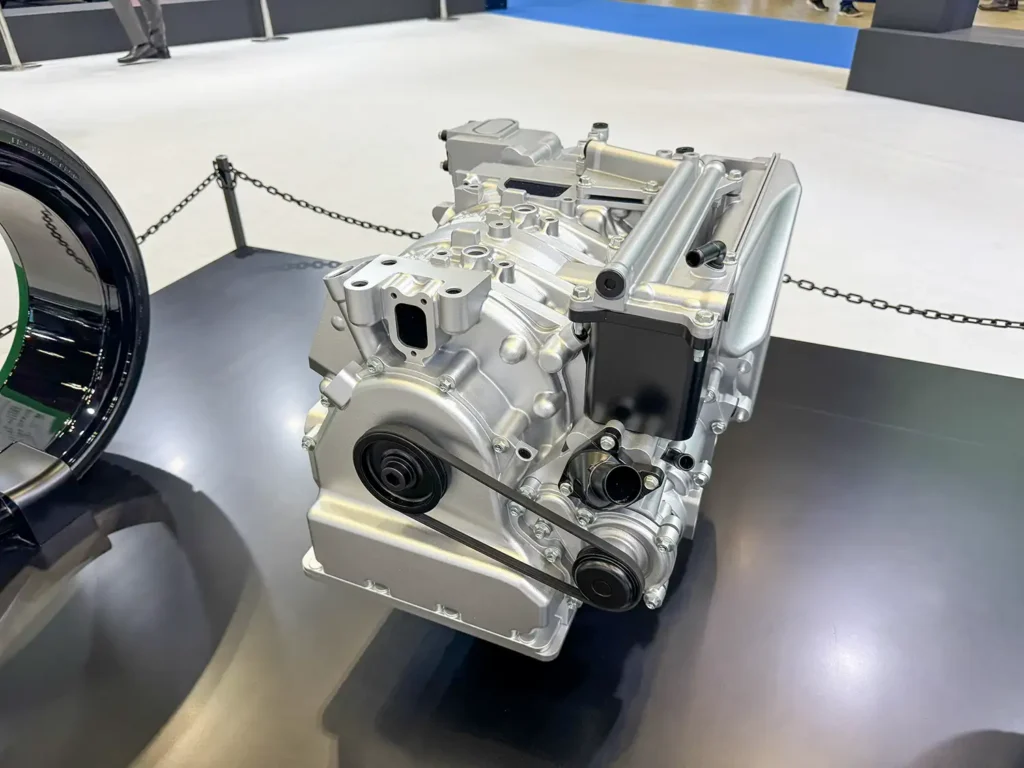
At the Japan Mobility Show Bizweek 2026, Mazda strongly highlighted the potential of the “rotary engine” as a next-generation internal combustion engine by exhibiting a concept model of a rotary EV system. This model, first introduced at the Multi-Pathway Workshop two and a half years ago, is based on the unit from the already mass-produced MX-30 ROTARY-EV. It envisions a mechanism where a twin-rotor rotary engine operates as a generator, charging the battery to drive the motor.
The Greatest Strength: “Omnivorousness”
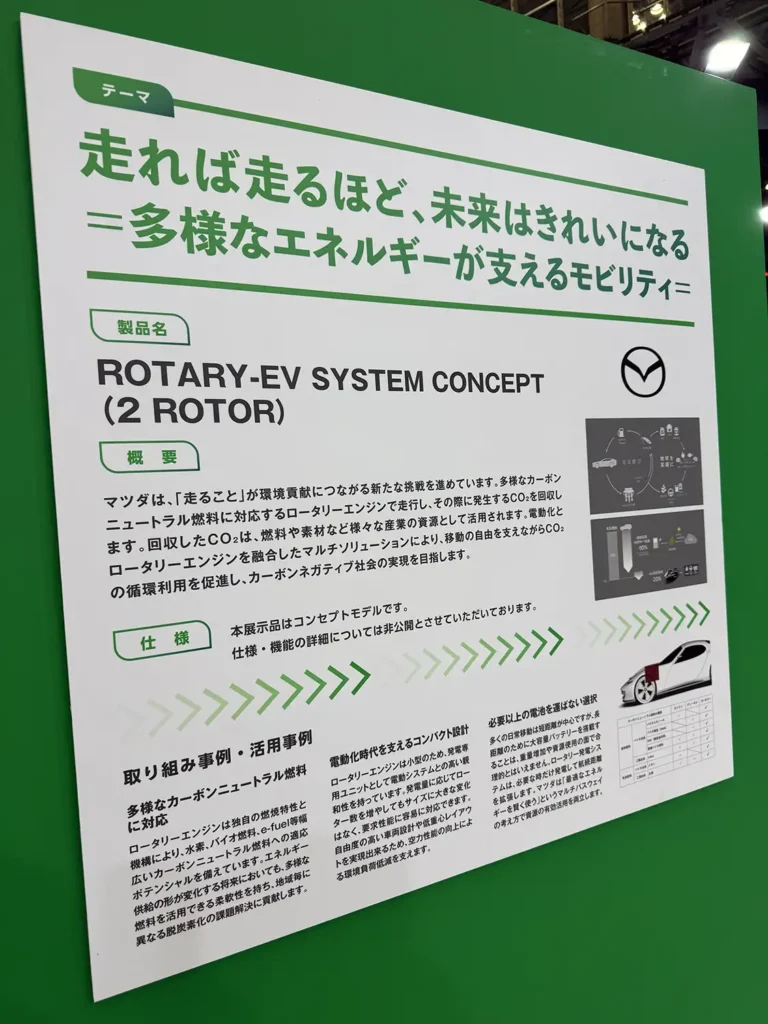
While the entire automotive industry is groping in the dark toward carbon neutrality, the biggest reason Mazda continues to develop the rotary engine lies in its overwhelming “omnivorousness” (versatility). Current EV (electric vehicle) development faces the dilemma of battery weight. For instance, even if a user only drives long distances on weekends, carrying a massive, heavy battery at all times is far from optimal in terms of energy efficiency. This is where the “range extender” approach—using an engine to generate only the necessary amount of electricity to charge the battery—becomes effective. Compact and highly powerful, the rotary engine is exceptionally well-suited as a generator.
Risk Hedging for Future Energy Infrastructure
Even more important is its role as a “risk hedge” for future energy infrastructure. Currently, research is progressing on various next-generation fuels, such as hydrogen, synthetic fuels (e-fuels), and biofuels. However, no one can predict which fuel will ultimately become the most affordable and widely adopted in the future.
Yet, due to its structural design, the rotary engine has the advantage of flexibly adapting to almost all currently conceivable next-generation fuels. If biofuels become inexpensive and mainstream in the future, as long as the rotary engine exists, there will be no need to develop new power units from scratch. Naturally, there will also be no need to carry the heavy batteries essential for pure EVs.
Looking toward such a future, Mazda is also considering achieving a “carbon negative” state—where more CO2 is absorbed than emitted—by combining this with “carbon capture” technology, which was also showcased at the exhibition.
The Seriousness Shown by a Dedicated Department
The characteristic of being able to “burn anything” is the ultimate survival strategy in the highly uncertain race for next-generation fuels. Mazda has never given up on this technology; a few years ago, they re-established a specialized development department for rotary engines and are continuing research and development, including responses to even stricter future emissions regulations.
Capable of adapting no matter which fuel achieves dominance, the rotary engine is not mere nostalgia, but rather one of the most highly rational and realistic optimal solutions for next-generation powertrains.
[Reporting, Writing, and Photography]
The mono-think Editors
A web media outlet that explores the cutting edge of Japan’s “manufacturing” and “infrastructure” from the perspective of active IT engineers, offering a unique perspective.
[Research Cooperation & Related Links]
Mazda Co., Ltd.
Japan Mobility Show, Bizweek 2026